Data Analytics Career Path: A Complete Guide for Aspiring Professionals

Data has quietly become one of the most valuable assets a business owns and the people who can make sense of it are in serious demand. If you’ve been curious about moving into data analytics, whether you’re switching careers or upskilling in your current role, the good news is that the path is more open than it’s ever been. You don’t need a specific degree to start. What you need is the right set of skills, a way to prove them, and a structured plan to get there.
This guide walks through what a data analytics career actually looks like, the skills that matter, why certifications and hands-on learning have become so important, and how working professionals can realistically make the transition.
Why data analytics skills are so valuable today
Almost every industry now runs on data. Retailers track buying patterns, hospitals analyse patient outcomes, banks model risk, and marketing teams measure every click. All of that information is useless until someone can interpret it and that’s where analysts come in.
The demand shows up in the numbers. According to the U.S. Bureau of Labor Statistics, data science-related roles are projected to grow significantly faster than average occupations, with strong median wages compared to the wider job market. Whichever way you look at it, data-driven careers are expanding while many traditional roles shrink.
There’s another reason these skills are valuable: they compound. Learning to work with data doesn’t just qualify you for analyst roles – it makes you more effective in marketing, finance, operations, or product, because you can back decisions with evidence instead of guesswork. That’s why professional upskilling in data analytics has become one of the smartest career investments available today.
What a data analyst actually does
Before mapping the path, it helps to understand the destination and the job is more approachable than the jargon suggests.
A data analyst turns raw information into decisions. Businesses collect huge volumes of data, most of which sits unused. The analyst pulls the right data, cleans it up, finds patterns, and explains what it means to people who don’t work with numbers all day.
A typical week involves:
- Gathering data from databases, spreadsheets, and business tools
- Cleaning it – fixing duplicates, gaps, and inconsistent formatting (realistically, most of the job)
- Analysing it – spotting trends and answering questions like “why did sales dip last quarter?”
- Visualising it – building charts and dashboards that make findings clear
- Communicating it – turning analysis into recommendations a team can act on
Notice how much of that is problem-solving and communication rather than pure technical work. If you’re coming from a non-technical background, skills like clear thinking, curiosity, and attention to detail transfer directly – which is exactly why career-changers do well in this field.
Do you need a degree for a data analyst career?
This is the question that stops many people before they start, so let’s be clear: a specific degree is not a strict requirement for most analyst roles. Employers increasingly hire on demonstrated ability – can you actually clean data, query a database, and tell a clear story with it?
That said, this isn’t an argument against formal learning – quite the opposite. Whether you have a degree or not, what makes the difference is structured skill-building and proof you can do the work. A relevant qualification or certification signals that you’ve learned the fundamentals deliberately rather than picking things up at random, and that credibility matters when you’re competing for your first role. The point isn’t “skip education” – it’s that the right education is the one that builds real, job-ready skills.
So the honest framing is this: you don’t need to spend years on a degree you may not want, but you do need a credible, structured way to build data analytics skills. For most people – especially working professionals that means a focused certification plus real projects.
The core data analytics skills you’ll need
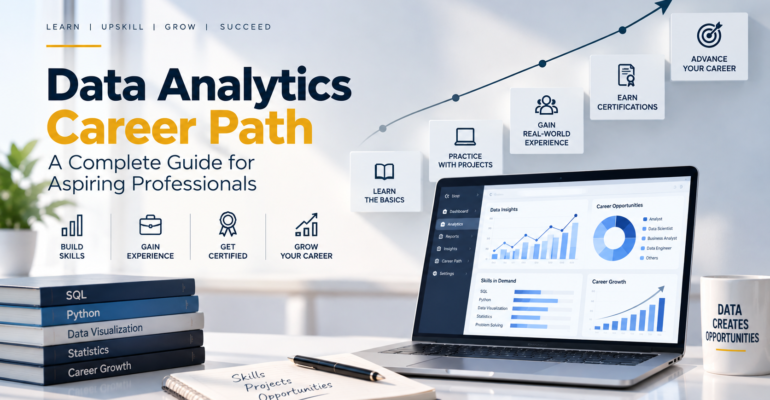
Focus your learning here, roughly in this order:
Technical skills
- Excel or Google Sheets – the fastest way to start thinking in data
- SQL – the language for pulling data from databases; the single most-requested analyst skill, so prioritise it
- Data visualisation – Tableau or Power BI, for turning numbers into dashboards
- Python or R – for larger datasets and more advanced analysis
- Basic statistics – enough to make sound, meaningful comparisons
Non-technical skills (just as important)
- Communication – explaining findings to non-technical people
- Problem-solving – turning a vague business question into a data question
- Attention to detail – catching errors in messy data
- Curiosity – the drive to keep asking “why?”
A sensible sequence is Excel → SQL → a visualisation tool → Python. Trying to learn everything at once is the fastest way to burn out; building one skill on top of the last keeps momentum.
Why certifications and structured learning matter
You can find free tutorials for all of these skills online – so why do certifications matter? Because scattered self-teaching leaves two gaps: you often don’t know what to learn next, and you have nothing that proves to an employer you’ve actually learned it.
Structured online certification programs solve both. They sequence the material logically, so you’re not guessing at the path, and they give you a recognised credential that fills the “how did you learn this?” question in an interview. For a career-changer without a data background, that credibility is genuinely valuable.
The best programs share a few features worth looking for:
- Full toolkit coverage – Excel, SQL, Python, and visualisation, not just one piece
- Hands-on projects – so you finish with portfolio work, not just a certificate
- Industry-relevant concepts – real business problems, not abstract theory
- Flexible, self-paced format – essential if you’re learning around a job
Structured online certification programs can help learners build these skills systematically through practical projects, industry-relevant concepts, and guided learning. Edvance Now provides structured, project-based learning opportunities through its Data Science Certification program, designed for working professionals who want to build practical data skills without pausing their careers.
Why hands-on projects matter more than anything
Here’s the part that actually gets people hired: a portfolio. Certificates open the door, but projects prove you can do the job.
Work on three or four projects using real, public datasets – government open-data portals and sites like Kaggle are free and full of them. Choose topics you find genuinely interesting, because your enthusiasm shows in the finished work. For each project, document the whole process: the question you asked, how you cleaned the data, what you found, and what you’d recommend. That narrative mirrors the real job far better than a certificate alone.
A practical shortcut for working professionals: analyse data from your current role. Being able to say “I analysed our team’s numbers and found X” is powerful in an interview, even before you hold the analyst title – and it proves you can apply skills to a real business context.
A realistic learning path for working professionals
If you’re juggling a full-time job, here’s a realistic frame:
- Months 1–2: Build Excel and SQL fundamentals. Get comfortable pulling and cleaning data.
- Months 3–4: Learn a visualisation tool and start your first portfolio project. Begin an online data science certification to structure your learning.
- Months 5–6: Add Python basics, complete two or three more projects, and refine your portfolio.
- Ongoing: Apply to entry-level and junior roles including adjacent titles like marketing analyst or operations analyst – leading with your portfolio.
Studying part-time at 5–10 hours a week, most people reach job-ready fundamentals plus a portfolio in six to twelve months. Full-time, it can be faster. Don’t rush toward an arbitrary deadline – a strong portfolio built over eight months beats a rushed one in three.
The bigger picture: AI and data-driven careers
One last reason to invest now: data analytics is a foundation, not a ceiling. The same skills open doors to fast-growing, AI and data-driven careers from business intelligence to data science to analytics roles within AI teams. As organisations lean harder on automation and machine learning, professionals who understand data are exactly the people they need, and pairing analytics with focused study like a Generative AI Certification can widen those options further.
Starting in data analytics doesn’t lock you into one job title. It positions you at the centre of where nearly every industry is heading.
How data analytics supports business decision-making
Data analytics is not only about numbers and tools; it helps businesses make better decisions. From understanding customer behaviour to improving operations and identifying growth opportunities, analytics allows professionals to support strategic decisions with real insights rather than gut feel.
This is why data skills have become valuable well beyond dedicated analyst roles. A manager who can read the numbers, a marketer who can measure what’s working, or an executive who can question a dashboard rather than take it at face value all make sharper decisions. For business professionals, learning to work with data isn’t a career detour; it complements broader business and management programs and is a way to lead with evidence.
Getting started
A career in data analytics is realistic, whatever your background. The path is clearer than it looks: build the core skills, prove them with hands-on projects, and back your learning with a structured, recognised certification. The demand is real and growing, and employers care about what you can do.
The hardest part is usually knowing what to learn and in what order which is where structured, project-based programs earn their value. Start with the fundamentals this week, and six months from now you could be applying with skills and a portfolio that speak for themselves.
Frequently Asked Questions
Do you need a degree to become a data analyst?
No, you don’t need a specific degree to become a data analyst. Most employers hire on demonstrated skills and a strong portfolio rather than formal qualifications alone. A structured data analytics certification plus real projects is often enough to land an entry-level role, especially as demand for data skills grows.
What skills do you need for a data analytics career?
The core data analytics skills are Excel, SQL, data visualisation (Tableau or Power BI), and Python or R, supported by basic statistics. Just as important are non-technical skills like communication, problem-solving, and attention to detail — analysts spend much of their time explaining findings to non-technical people.
How long does it take to become a data analyst?
Studying part-time at 5–10 hours a week, most people reach job-ready fundamentals and a portfolio in six to twelve months. Studying full-time can shorten this to three to six months. A structured certification usually speeds things up by removing the guesswork of what to learn next.
Is a data analytics certification worth it?
Yes, a data analytics certification is worth it for most career-changers and working professionals. It gives you a logical learning path, a recognised credential that answers the “how did you learn this?” question in interviews, and — in the best programs — hands-on projects for your portfolio. An online data science certification lets you build these skills around a full-time job.
Can I learn data analytics while working full-time?
Yes. Many people transition into a data analytics career through part-time, self-paced study alongside a full-time job. Structured online programs are designed for exactly this, letting you learn in the evenings and on weekends over several months without pausing your career.
What’s the difference between a data analyst and a data scientist?
A data analyst focuses on interpreting existing data to answer business questions and support decisions. A data scientist typically works on more advanced statistical modelling, machine learning, and prediction. Analyst roles are the more common and accessible entry point into data-driven careers.